
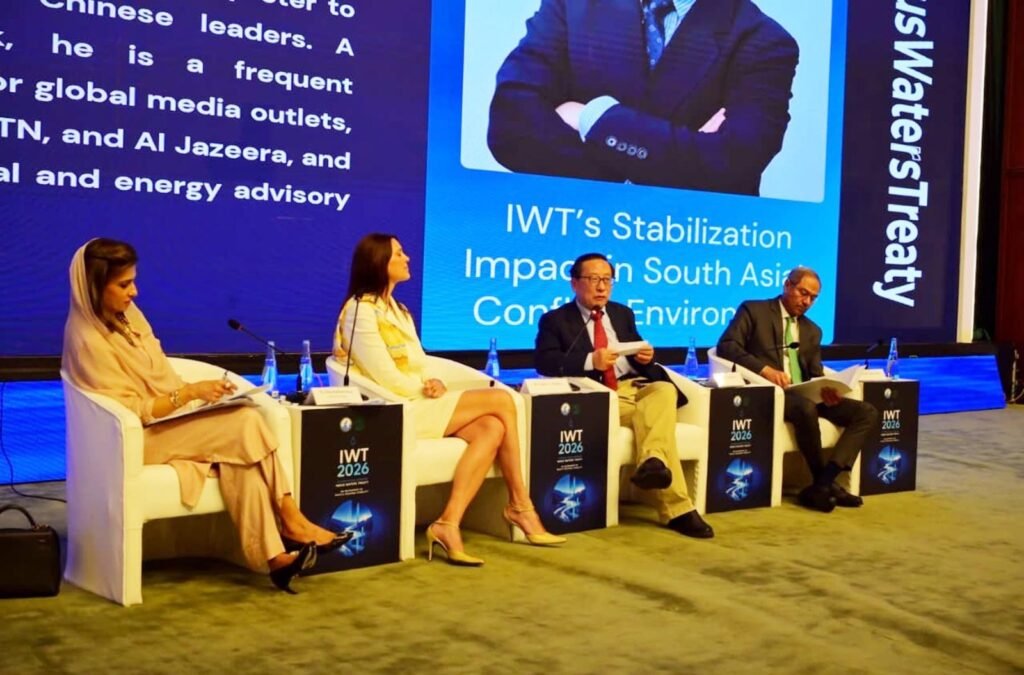
Executive Summary International Seminar “Indus Waters Treaty: An Instrument of Peace and Regional Stability,” jointly organized by MoIB and Institute of Regional Studies (IRS), convened national leadership, international legal scholars, diplomats, policymakers, water experts and strategic analysts to deliberate upon the legal, strategic, environmental and humanitarian dimensions of the Indus Waters Treaty (IWT) amid emerging regional and global challenges. Structured around two thematic technical sessions and a high-level concluding session, the seminar examined the Indus Waters Treaty from legal, institutional, strategic, humanitarian and environmental perspectives. Deliberations focused on the Treaty as an enduring legal and institutional framework for conflict prevention, while also assessing the implications of non-cooperation, evolving climate challenges, transboundary water governance, human security and the continued relevance of treaty-based mechanisms for sustaining regional peace and stability. The seminar reaffirmed the IWT as one of the world’s most successful and enduring transboundary water-sharing agreements, having withstood decades of political tensions and armed conflicts while continuing to serve as a model of peaceful cooperation founded on international law, institutional dialogue and mutually agreed obligations. Participants underscored that the Treaty remains a cornerstone of regional peace, stability and confidence-building, providing predictability and legal certainty for the management of shared water resources. A broad consensus emerged that unilateral attempts to suspend, alter or place the Treaty in abeyance are incompatible with its legal framework and undermine the fundamental principles governing international agreements. Participants emphasized that the sanctity of treaties, respect for international commitments and peaceful settlement of disputes constitute essential pillars of the rules-based international order. Any erosion of these principles, it was observed, carries implications extending far beyond South Asia by weakening confidence in international legal obligations and multilateral institutions. The seminar highlighted the growing strategic importance of the Treaty in the context of climate change, accelerating glacier melt, increasing hydrological variability, recurrent floods, prolonged droughts and rising water insecurity. Participants noted that stable, transparent and cooperative management of transboundary rivers has become increasingly critical for ensuring food security, disaster preparedness, sustainable development and regional resilience. Particular emphasis was placed on the indispensable role of timely hydrological data sharing, technical cooperation and institutional engagement in safeguarding downstream populations. Deliberations also examined the humanitarian dimensions of transboundary water governance, recognizing that the Indus River system sustains the livelihoods, agriculture, economy and food security of over 240 million Pakistanis. Participants stressed that water should never be weaponized or employed as an instrument of political coercion, reaffirming that equitable, predictable and cooperative management of shared rivers remains a prerequisite for lasting peace and sustainable development. International experts participating in the seminar observed that the issues confronting the Indus Basin increasingly reflect broader global challenges associated with transboundary water governance. The seminar therefore called for strengthening international legal norms, enhancing cooperation among riparian states and reinforcing institutional mechanisms that protect shared freshwater resources and the rights of downstream communities worldwide. The conference further underscored Pakistan’s continued commitment to resolving all Treaty-related matters through the legal, institutional and diplomatic mechanisms provided under the IWT and international law. Participants reiterated that adherence to established dispute-resolution processes, constructive dialogue and good-faith implementation of treaty obligations remain the only sustainable path toward regional stability and mutual confidence. Concluding the proceedings, the seminar reaffirmed that the preservation of the IWT is not solely a bilateral imperative but a matter of wider international significance. Protecting its integrity serves to reinforce the credibility of international law, strengthen the global rules-based order and promote the peaceful, cooperative and sustainable management of shared natural resources for present and future generations.

















Post your comments